publish: true
aliases:
- Martyr
created: 2026-03-09T12:15:33.878-04:00
modified: 2026-03-09T12:15:33.878-04:00
published: 2026-03-09T12:15:33.878-04:00
tags: - ttrpg-cli/class/martyr
- ttrpg-cli/compendium/src/5e/valdaspire24
cssclasses: - json5e-class
obsidianUIMode: preview
Martyr
Source: Valda’s Spire of Secrets (2024)
Class and Feature Progression
Level PB Features Prepared Spells Max Spell Levels Spell Uses 1st +2 Armor of Faith, Spellcasting, Weapon Mastery 2 1 2 2nd +2 Miraculous Healing, Reprisal 3 1 2 3rd +2 Martyr Subclass, Sacrifice 4 1 3 4th +2 Ability Score Improvement 5 1 3 5th +3 Extra Attack 6 2 6 6th +3 Subclass Feature 6 2 6 7th +3 Sacrifice Foe 7 2 7 8th +3 Ability Score Improvement 7 2 7 9th +4 Divine Respite 8 3 9 10th +4 Undying 8 3 9 11th +4 Improved Sacrificial Strike 10 3 10 12th +4 Ability Score Improvement 10 3 10 13th +5 Divine Respite 11 4 11 14th +5 Subclass Feature 11 4 11 15th +5 March Unto Destiny 12 4 12 16th +5 Ability Score Improvement 12 4 12 17th +6 Divine Respite, Improved Sacrificial Strike 14 5 14 18th +6 Subclass Feature 14 5 14 19th +6 Epic Boon 15 5 15 20th +6 Final Martyrdom 15 5 15
Hit Points
- Hit Dice: 1d12 per Martyr level
- Hit Points at First Level: 12 + CON
- Hit Points at Higher Levels: add 7 OR 1d12 + CON (minimum of 1)
Starting Martyr
- Saving Throw Proficiencies: Strength, Wisdom
- Skill Proficiencies: Choose 2: Athletics, History, Insight, Intimidation, Medicine, Persuasion, or Religion
- Weapon Proficiencies: Simple weapons and Martial weapons
- Armor Training: Light armor and Shields
Starting Equipment: Choose A, B, or C: (A) Scale Mail, Shield, Longsword, 6 Javelins, Holy Symbol, Priest’s Pack, and 29 GP; (B) Studded Leather Armor, 2 Daggers, 2 Shortswords, Longbow, 20 Arrows, Quiver, Holy Symbol, Priest’s Pack, and 11 GP; or (C) 170 GP
Multiclassing Martyr
- Weapon Proficiencies: Martial weapons
- Armor Training: Light armor, Shields

Martyr
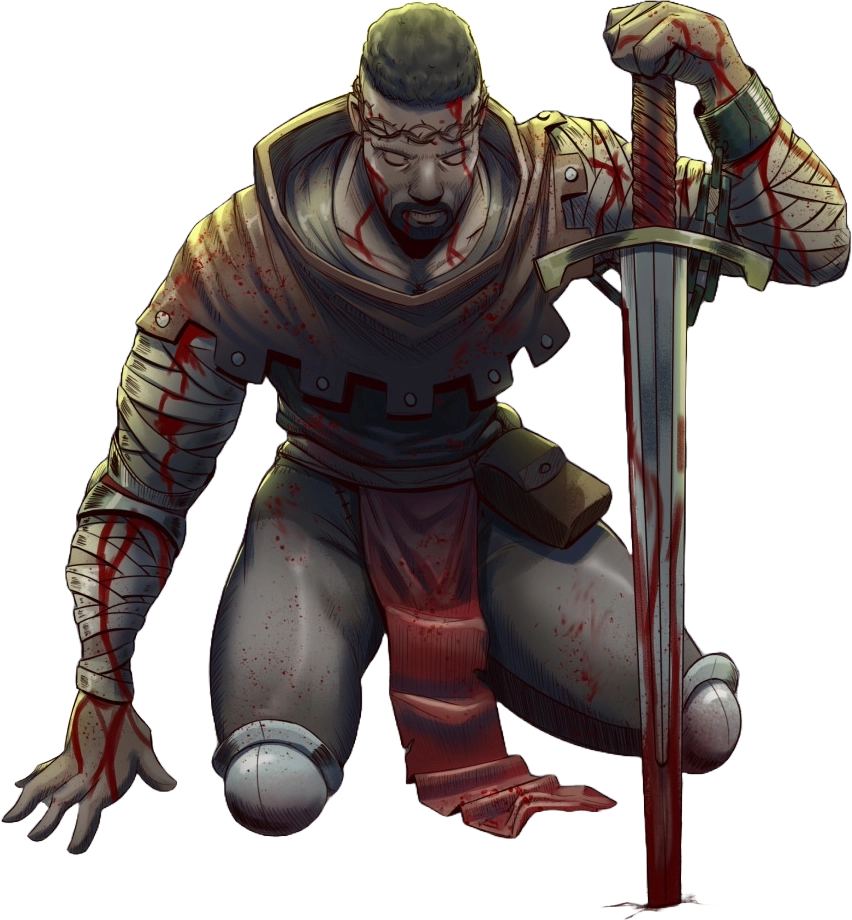
Martyrs are implements of the gods, handpicked to die in service of a divine cause. Such an end is inevitable, for once a martyr is chosen, their fate is fixed in the heavens.
Fated to Die
Martyrs are chosen by the gods, predestined to die for a great cause. They are prophets and oracles, great priests and liberators. Some Martyrs struggle against their destiny, but from the moment they are chosen, invisible strings of fate pull them onward. The gods may settle for a lesser Martyr if the one chosen is unwilling, but they always prefer to uplift their Martyr to the heights of sainthood before their inevitable demise.
Sacrifice
The gods invest their Martyr with deep wellsprings of power, but this power demands sacrifice. Drawing upon divine magic scorches a Martyr with radiance and wracks their body with pain. But the gods will never kill their charge early, and so offer healing in equal measure. Their Martyr shall meet their fate at the preordained time, and not a moment sooner.
Class Features
Armor of Faith (Level 1)
Your divine connection shields you from harm. You gain one of the following benefits of your choice.
Anointed Armor. You have training with Medium armor. While you are wearing armor, you can add your Wisdom modifier, instead of your Dexterity modifier, to your Armor Class.
Unarmored Defense. While you aren’t wearing any armor, your base Armor Class equals 10 plus your Dexterity and Wisdom modifiers. You can use a Shield and still gain this benefit.
Spellcasting (Level 1)
The gods demand that you sacrifice Hit Points to cast divine magic.
Hit Point Spellcasting. To cast one of your level 1+ Martyr spells, you take Radiant damage to create a spell slot for that spell, which is immediately expended to cast it. The amount of Radiant damage you take is listed in the Damage column on the Hit Point Spellcasting table. This damage ignores Resistance and Immunity and bypasses Temporary Hit Points.
When you cast a Martyr spell, you choose the level of spell slot that you create, whose level is no higher than what’s shown in the Max Slot Level column of the Martyr Features table for your level.
Hit Point Spellcasting
| Spell Slot Level | Damage |
|---|---|
| 1 | 5 |
| 2 | 10 |
| 3 | 20 |
| 4 | 30 |
| 5 | 40 |
| ^hit-point-spellcasting |
Spell Uses. When you cast one of your level 1+ Martyr spells, you expend one use of your spell uses in addition to taking Radiant damage. You can cast a total number of spells up to the number listed in the Spell Uses column of the Martyr Features table. You regain all spell uses when you finish a Long Rest.
Prepared Spells of Level 1+. You prepare the list of level 1+ spells that are available for you to cast with this feature. To start, choose two level 1 Martyr spells. Command and Guiding Bolt are recommended.
The number of spells on your list increases as you gain Martyr levels, as shown in the Prepared Spells column of the Martyr Features table. Whenever that number increases, choose additional Martyr spells until the number of spells on your list matches the number in the table. The chosen spells must be of a level no higher than what’s shown in the table’s Max Slot Level column for your level.
If another Martyr feature gives you spells that you always have prepared, those spells don’t count against the number of spells you can prepare with this feature, but those spells otherwise count as Martyr spells for you.
Changing Your Prepared Spells. Whenever you finish a Long Rest, you can replace one spell on your list with another Martyr spell for which you have spell slots.
Concentration. When a Martyr feature causes you to take Radiant damage, you don’t make Constitution saving throws to maintain Concentration as a result of taking this damage.
Healing Magic. Because your power is derived from mortal suffering, you can’t regain Hit Points from any spell you cast.
Spellcasting Ability. Wisdom is your spellcasting ability for your Martyr spells.
Spellcasting Focus. You can use a Holy Symbol as a Spellcasting Focus for your Martyr spells.
Weapon Mastery (Level 1)
Your training with weapons allows you to use the mastery properties of two kinds of weapons of your choice with which you have proficiency, such as Javelins and Longswords.
Whenever you finish a Long Rest, you can change the kinds of weapons you chose.
Miraculous Healing (Level 2)
As a Bonus Action, you can heal your own wounds. Roll one of your unexpended Hit Point Dice and regain a number of Hit Points equal to the roll’s total plus your Constitution modifier. This die is then expended.
As you gain Martyr levels, you can expend more dice each time you use this feature, adding your Constitution modifier to each Hit Point Die you roll. The number of Hit Point Dice you can expend equals half your Martyr level, round down.
Reprisal (Level 2)
When you take damage from a creature you can see within 5 feet of yourself, you can take a Reaction to halve the damage taken. The creature takes 1d6 Necrotic or Radiant damage (your choice).
At Higher Levels. The damage increases by 1d6 when you reach Martyr levels 5 (2d6), 11 (3d6), and 17 (4d6).
Martyr Subclass (Level 3)
You gain a Martyr subclass of your choice. A subclass is a specialization that grants you features at certain Martyr levels. For the rest of your career, you gain each of your subclass’s features that are of your Martyr level or lower.
Sacrifice (Level 3)
The gods demand that you undergo trials to curry their favor, granting you the following benefits.
Sacrificial Strike. When you deal damage to a creature with a Melee weapon or Unarmed Strike, you can take a Bonus Action to enhance the strike. You take 5 Radiant damage and the target takes an extra 10 Radiant damage. This damage ignores your Resistance and Immunity, and bypasses your Temporary Hit Points.
Sacrificial Skill. Once per turn when you fail a D20 Test, you can take 10 Radiant damage to gain a +5 bonus to that roll, potentially turning it into a success. This damage ignores your Resistance and Immunity, and bypasses your Temporary Hit Points. If the test still fails, you don’t take this Radiant damage.
Ability Score Improvement (Level 4)
You gain the Ability Score Improvement feat or another feat of your choice for which you qualify.
Extra Attack (Level 5)
You can attack twice instead of once whenever you take the Attack action on your turn.
Subclass Feature (Level 6)
You gain a feature from your Martyr Subclass.
Sacrifice Foe (Level 7)
When you make an attack or damage roll that is improved by your Sacrifice feature, and the attack reduces an enemy to 0 Hit Points, you don’t take Radiant damage from using the feature.
Ability Score Improvement (Level 8)
You gain the Ability Score Improvement feat or another feat of your choice for which you qualify.
Divine Respite (Level 9)
When you finish a Short Rest, you can choose to regain up to 3 expended Hit Point Dice. Once you use this feature, you can’t do so again until you finish a Long Rest.
The number of expended Hit Point Dice you regain increases when you reach levels 13 (6 Hit Point Dice) and 17 (10 Hit Point Dice).
Undying (Level 10)
When you are reduced to 0 Hit Points but not killed outright, you can drop to 1 Hit Point instead and you can immediately use your Miraculous Healing (no action required).
Once you use this feature, you can’t do so again until you finish a Long Rest.
Improved Sacrificial Strike (Level 11)
Your Sacrificial Strike improves. When you use this feature, you can choose to take 10 Radiant damage, and the target takes an extra 20 Radiant damage.
At Martyr level 17, the first time you use your Sacrificial Strike on each of your turns, you can do so without taking a Bonus Action.
Ability Score Improvement (Level 12)
You gain the Ability Score Improvement feat or another feat of your choice for which you qualify.
Divine Respite (Level 13)
When you finish a Short Rest, you can choose to regain up to 6 expended Hit Point Dice. Once you use this feature, you can’t do so again until you finish a Long Rest.
Subclass Feature (Level 14)
You gain a feature from your Martyr Subclass.
March Unto Destiny (Level 15)
You don’t need to eat or drink, and have Immunity to the Paralyzed, Petrified, and Stunned conditions.
Ability Score Improvement (Level 16)
You gain the Ability Score Improvement feat or another feat of your choice for which you qualify.
Divine Respite (Level 17)
When you finish a Short Rest, you can choose to regain up to 10 expended Hit Point Dice. Once you use this feature, you can’t do so again until you finish a Long Rest.
Improved Sacrificial Strike (Level 17)
The first time you use your Sacrificial Strike on each of your turns, you can do so without taking a Bonus Action.
Subclass Feature (Level 18)
You gain a feature from your Martyr Subclass.
Epic Boon (Level 19)
You gain an Epic Boon feat or another feat of your choice for which you qualify.
Final Martyrdom (Level 20)
You have at last reached your predestination: you will die in eternal glory. As a Magic action, you can gain the following benefits for 10 minutes. At the end of the duration, you die. No force, short of a Cleric’s Divine Intervention, can prevent your death, and you can’t be returned to life by any means.
Advantage. You have Advantage on all D20 Tests.
Immunities. You have Immunity to all damage and to all conditions except for the Grappled, Invisible, Prone, and Unconscious conditions.
Wish. You can cast Wish once without a spell slot. You suffer no stress from using effects other than duplicating another spell.
Quiet Martyrdom
Not all stories of martyrdom end in dramatic confrontations with implacable foes. Occasionally a Martyr’s sacrifice achieves a peaceful conclusion and satisfies the gods without costing their life. Nevertheless, the stories of these Martyrs still come to a close—they don’t continue adventuring once their ultimate goal has been fulfilled. Perhaps they might retire to a distant hermitage, wander into the desert, or simply disappear into a crowd, never to be seen again.